

There is a song that lives between two worlds. It has no fixed address – not quite Indian, not quite Caribbean – and yet it belongs entirely to both. Born of longing and shaped by the sea, it is the sound of a people who refused to let go of who they were, even as the world around them changed beyond recognition. It is the song of the Girmitiyas, and it is still being sung.
The word girmit is itself a story. It is how the indentured labourers of the 19th century pronounced “agreement” – the colonial contract that bound them to sugar plantations far from home. They took this word, this document of their displacement, and made it their own. Girmitiyas: those of the agreement. Those who signed their names – or pressed their thumbprints – and crossed the black water into the unknown. And in doing so, they changed the world.
The Journey Begins
On the 13th of January 1838, a ship called the Whitby left the shores of India carrying some of the first Indian indentured labourers bound for the British colony of Guiana on the northeastern coast of South America. Weeks later, the Hesperus followed. Together, they carried 396 souls – men, women, and a handful of children – from the villages of Chota Nagpur, Bihar, and Bengal, to the cane fields along the Demerara River.
They arrived on the 5th of May 1838. Today, Guyana marks that day as Indian Arrival Day.
What these travellers left behind was not simply geography. They left the Ganga – the river that runs through the Bhojpuri heartland of North India, the river of prayers and rituals, the river whose name they would whisper for generations in a land where no such river existed. In Demerara, they found the brown, wide waters of a different river entirely. But they carried the Ganga with them, in memory and in song, in the clay diyas they lit at dusk, in the stories they told their children at night.
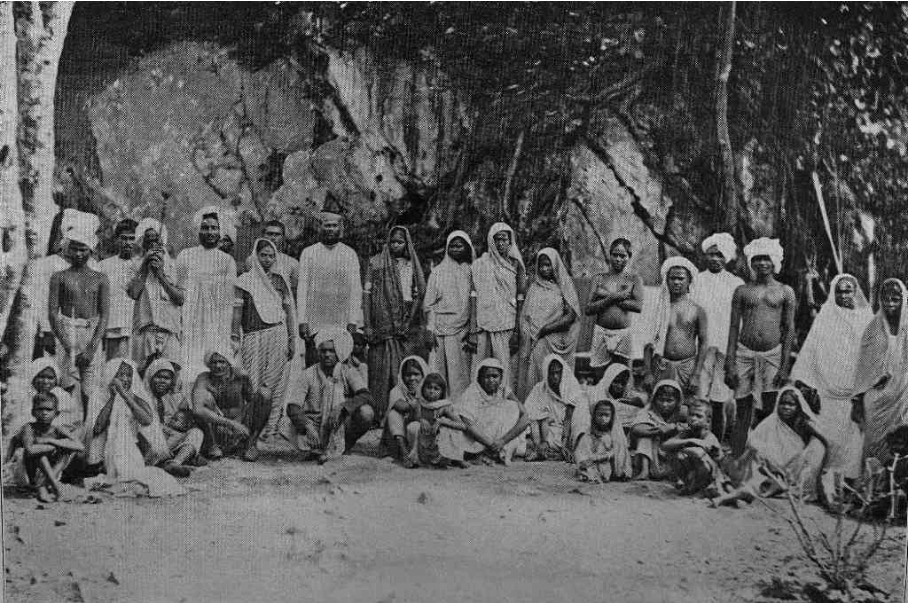
From 1838 to 1917, ships sailing from Calcutta and Madras brought roughly 238,000 Indians to British Guiana alone – and over a million more to colonies across the globe, from Trinidad and Jamaica to Fiji, Mauritius, and Suriname. They came under contracts of indenture, promised light work and good wages. What they found was something far harder: long days in the cane fields, poor shelter, scant food, and the constant loneliness of a world that felt nothing like home.
And yet – they endured. More than endured. They created.
The Art Born of Ache
There is something profound about a people who, in the depths of displacement, turn to art. The Girmitiyas did not simply survive; they sang.
In the barracks and on the plantations, it was often the women who held culture together. They sang birha – songs of separation, of the beloved left behind, of the cowherds calling out across empty fields – to make sense of their own uprooting. They sang sohar to welcome new life into the world. They sang chowtal at Phagwa, kajri in the rains. The folk forms of Uttar Pradesh and Bihar – thumri, chaiti, barahmasa – crossed the ocean with them, tucked inside the chest alongside a handful of turmeric and a folded piece of cloth.
These were not simply entertainment. These songs were memory made audible. They were the Ganga, the mango grove, the scent of mustard flowers – compressed into melody and carried forward. And as generations passed, something extraordinary began to happen: the music changed. It met the Caribbean. It listened to the steel drum and the African rhythm and the Creole tongue, and it made something new.
Chutney music – joyful, syncretic, irrepressible – is perhaps the most beloved cultural gift of the Girmitiya legacy. With its Bhojpuri lyrics and Caribbean rhythms, played on harmonium and dhantal alongside bass guitar and synthesiser, it is a music that could only have been born in the space between two worlds. As musicologist Professor Peter Manuel has noted, these traditional musical forms “evolved in the diaspora into vibrant contemporary styles,” blending old and new influences into something distinctly alive. Tassa drumming, local classical music, the dholak at a wedding – all carry the fingerprints of those first arrivals, transformed but unbroken.
It was mostly the women, historians remind us, who kept these traditions alive on the plantations – singing Bhojpuri wedding songs at matikoor, the lively nights before a wedding. Quietly, devotedly, they were the custodians of a culture. The artists who never called themselves artists.
The Jahaji Bond: A New Family
On those long sea voyages – sometimes three months, sometimes more – something remarkable was forged in the hold of the ships. Strangers from different castes, different regions, different faiths found themselves thrown together by shared circumstance. They called each other jahaji bhai and jahaji bahin – ship brothers and ship sisters. The hierarchy of caste, so rigid back home, began to dissolve in the saltwater air.
This was a radical act of reinvention. The Girmitiyas did not simply transplant Indian society to the Caribbean; they rebuilt it. They kept what was precious – their prayers, their festivals, their music, their food — and they shed what no longer served them. They became something new: Indo-Caribbean. A hyphenated identity, yes, but one worn with tremendous dignity and pride.
Dr. Vishnu Bisram, speaking at a recent Indo-Caribbean Cultural Centre forum, captured this beautifully: “Resilience, creativity and adaptability have led to cultural preservation and persistence of Indian culture in not only Guyana, but in Trinidad and Suriname and in the diaspora largely.” He expanded the definition of culture itself – not merely music and dance, but “a total way of life: clothing, language, food, decorations, how they pray, their rituals, their festivals.” The Girmitiyas preserved all of it, against remarkable odds.
Festivals like Diwali and Phagwa (Holi) are now woven into the national fabric of Guyana and Trinidad. The tabla and the harmonium sound at weddings alongside the latest pop hit. Temples rise along streets named after colonial administrators. The sacred and the syncretic, side by side – this is the Girmitiya inheritance.
Memory, Preserved and Living
The Records of the Indian Indentured Labourers – spanning Guyana, Trinidad and Tobago, Suriname, and Fiji from 1838 to 1917 – were inscribed on UNESCO’s Memory of the World Register in 2011. They are, as UNESCO notes, “the only source of genealogy” for each Girmitiya. Names, ages, places of origin, the ships they sailed on – all there, in faded ink, the paper ghosts of living people.
But legacy is not only what lives in archives. It lives in kitchens where dal puri is rolled by hand on Sunday mornings. It lives in the parai drum, which a new generation of young musicians – as scholar Ari Gautier observes – are now traveling to South India to learn to make and play, reclaiming a tradition their great-grandparents carried across the water. It lives in literature: writers like Gaiutra Bahadur, whose book Coolie Women traces her great-grandmother’s journey through indenture, bringing those unnamed, faceless women back into history.
It lives on stages.
Across the Caribbean and in diaspora communities in New York, Toronto, London, and Amsterdam, performing arts groups celebrate and interpret the Girmitiya story through dance, theatre, and music. The Guyana Cultural Association of New York, now marking 25 years of its folk festival, hosts events that bring maypole plaiting and folk dancing alongside storytelling and music composition – a living curriculum of identity. Their MoBraff Performing Arts Festival is a space where the old songs meet new voices, where a teenager in Brooklyn might hear a birha melody for the first time and feel something ancient stir.
This is what culture does when it is truly loved: it refuses to stay in the past.
A Legacy Still Unfolding
The story of the Girmitiyas is not a closed chapter. It is a conversation still ongoing – between India and the Caribbean, between the past and the present, between what was lost and what was made in its place.
There is a movement growing among younger members of the diaspora to know this history more deeply – to trace the exact villages their ancestors came from, to learn Bhojpuri, to understand the girmit agreement that their forebears signed in hope and uncertainty. India and the Caribbean are strengthening their ties in recognition of this shared history. Initiatives like the Pravasi Teerth Darshan Yojana invite diaspora members back to the land of their ancestors, closing a circle that began nearly two centuries ago.
And yet, what moves most about the Girmitiya story is not the politics or the policy. It is the human heart at the centre of it. It is the image of a woman on a sugar plantation in Demerara, a world away from everything she knew, singing a wedding song – not for herself, but so her daughter might one day know the melody. It is the knowledge that culture is not merely what we inherit, but what we choose to carry forward.
The Girmitiyas carried the Ganga to Demerara in their hearts and planted it there. It grows still.