Indian classical music is one of the oldest unbroken musical traditions in the world. Rooted in the Vedas and evolving over centuries, it has maintained a delicate balance between rigorous discipline and creative freedom. This article introduces the foundational concepts that form the basis of Indian classical music, both Hindustani (North Indian) and Carnatic (South Indian) traditions.
1. Historical and Philosophical Foundations
Indian classical music traces its origins to the Samaveda, which prescribed musical chanting of hymns in specific melodic patterns. Over time, these evolved into raga and tala systems that embedded musical practice with spiritual, aesthetic, and meditative goals.
The philosophical principle of Nada Brahma, “Sound is God”, illustrates how sound is treated not merely as auditory experience but as a sacred medium. The ultimate goal of music is to evoke rasa, or emotional essence, aligning with both metaphysical and artistic frameworks.
2. Nada (The Essence of Sound)
Nada, or sound, is categorised into:
Anahata Nada (unstruck/internal sound), experienced in meditation.
Ahata Nada (struck/external sound), produced by instruments or voice.
Indian music treats Nada as a vibrational force that is central to the creative process. Vocalists and instrumentalists strive to generate pure, resonant sound, which becomes the foundation for all further musical elaboration.
3. Swara (Musical Notes)
There are seven basic swaras:
Sa, Re, Ga, Ma, Pa, Dha, Ni
Sa and Pa are constant (achala swaras), while the others (vikrta swaras) can vary in pitch. These swaras form the Saptak (octave) and are foundational to both vocal and instrumental performance.
In Carnatic music, swaras are further divided into multiple pitch variants, resulting in 16 swarasthanas or tone positions.
4. Saptak and Shruti (Octave and Microtones)
The Saptak is divided into:
Mandra Saptak (lower)
Madhya Saptak (middle)
Tara Saptak (higher)
Within these lie Shrutis, or microtones. Ancient texts mention 22 Shrutis within an octave, although modern usage focuses on the precise intonation of swaras rather than distinct microtones.
5. Raga (The Melodic Framework)
A raga is more than a scale – it is a melodic and emotional structure with defined rules for ascending (arohana) and descending (avarohana) movements.
Characteristics of a Raga:
- Arohana/Avarohana
- Vadi/Samvadi (dominant/secondary notes)
- Pakad (signature phrases)
- Jati (classification by number of notes)
- Rasa (emotional flavour)
Each raga invokes a specific mood, and in Hindustani tradition, is associated with time of day or season. Carnatic music is less strict about time but retains the mood-oriented essence.
6. Raga Classification: Thaat and Melakarta Systems
Hindustani – Thaat System:
Devised by Vishnu Narayan Bhatkhande, the Thaat system classifies ragas under ten parent scales such as Bilawal, Kafi, Kalyan, Asavari, Bhairav, Marwa, Poorvi, Thodi, Bhairavi, and Khamaj.
Carnatic – Melakarta System:
Carnatic music follows the 72 Melakarta ragas, all of which are sampoorna ragas (seven notes in both directions). Derived ragas, called Janya Ragas, are based on these parent scales.
7. Tala (Rhythmic Structure)
Tala is the rhythmic framework of Indian classical music. It consists of cycles of beats (matras), each divided into vibhags or angas. The first beat is called sam and is of prime importance.
Hindustani Talas: examples-
Teentaal (16 beats)
Jhaptaal (10)
Ektaal (12)
Carnatic Talas: examples-
Adi Tala (8 beats)
Rupaka Tala (6)
Khanda Chapu (5)
The Suladi Sapta Tala system in Carnatic music, with 7 talas and 5 jatis, results in 35 primary talas.
8. Laya (Tempo)
Laya refers to tempo and is classified into:
- Vilambit (slow)
- Madhya (medium)
- Drut (fast)
Musicians must master layakari – manipulation of rhythm through tempo shifts and polyrhythmic patterns. This is particularly essential in improvisational sections like Tan in Hindustani and Kalpana Swaras in Carnatic music.
9. Composition Forms
Both traditions use specific compositional structures:
Hindustani Forms:
- Dhrupad: Ancient, serious, devotional.
- Khayal: Most prominent, lyrical, improvisational.
- Thumri, Tappa, Tarana: Lighter genres.
Carnatic Forms:
- Varnam: Introductory, technical.
- Kriti: Main composition, usually by Trinity composers like Tyagaraja.
- Padam, Javali, Tillana: Used for expressiveness and rhythmic flourish.
Each composition is set in a raga and tala and is used as a base for both structured rendition and manodharma sangeetham (creative improvisation).
10. Improvisational Techniques
Improvisation is a defining feature of Indian classical music.
Hindustani:
- Alap: Free-flowing raga exploration.
- Jod/Jhala: Rhythmic development.
- Tans: Fast melodic runs.
Carnatic:
- Raga Alapana: Non-rhythmic raga exposition.
- Niraval: Improvising on a lyrical phrase.
- Kalpana Swaras: Improvised swara patterns.
- Ragam-Tanam-Pallavi: An elaborate and scholarly performance form.
11. Instruments in Indian Classical Music
Hindustani Instruments:
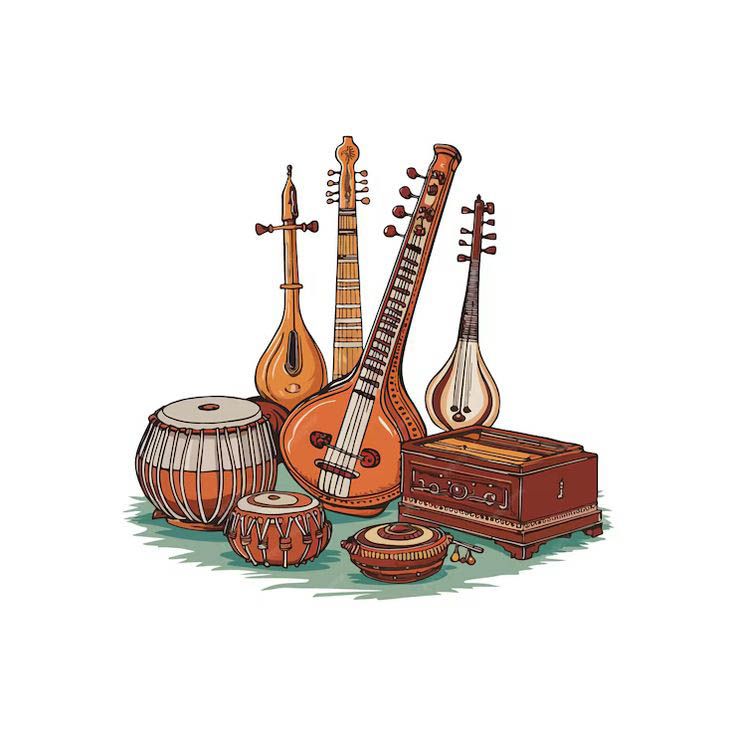
- Melody: Sitar, Sarod, Bansuri, Santoor
- Rhythm: Tabla, Pakhawaj
- Drone: Tanpura
Carnatic Instruments:
- Melody: Veena, Violin, Flute
- Rhythm: Mridangam, Ghatam, Kanjira
- Drone: Tambura
Many instruments are designed to emulate vocal techniques, as vocal music is considered the ideal form.
12. Bhava and Rasa (Emotion and Expression)
The goal of Indian music is to evoke rasa, or the emotional flavour experienced by the audience. Navarasa, or the nine rasas – including shringara (love), karuna (compassion), and veera (heroism) – guide emotional expression.
Musicians use gamakas (ornamentations), dynamics, and tempo variation to enhance bhava (feeling), making performance a communicative and aesthetic experience.
13. Guru-Shishya Parampara (Traditional Learning)
The Guru-Shishya tradition emphasises oral transmission of knowledge, lifelong dedication, and immersive learning. This system values sadhana (rigorous practice) over academic grades, ensuring mastery over technique and theory through lived experience.
While modern institutions offer degrees, the one-on-one mentorship model remains a respected and often essential path for serious musicians.
14. Notation Systems
Hindustani:
Bhatkhande’s notation uses Devanagari with symbols for swaras, matras, and tempo.
Carnatic:
Notation uses swaras (sa, ri, ga…) and numbers to indicate rhythmic groupings. However, both systems acknowledge that notation is insufficient to convey gamakas, hence the primacy of oral transmission.
15. Contemporary Relevance
Indian classical music continues to thrive globally through festivals, institutions like Sangeet Natak Akademi, The Music Academy (Madras), and innovations in fusion and media. Its adaptability allows for experimentation without compromising its classical integrity.
The foundational principles of Indian classical music including Nada, Swara, Raga, Tala, and Rasa, together form an integrated and comprehensive system that synthesises aesthetic sensibility, structural precision, and spiritual philosophy. Transmitted primarily through oral pedagogical traditions and continually refined through centuries of practice, these interrelated concepts have sustained the continuity of the tradition while enabling its dynamic evolution, shaping generations of musicians who both preserve and reinterpret this enduring musical heritage.