

Indian music, one of the oldest musical traditions in the world, has evolved over thousands of years, deeply intertwined with religious, cultural, and philosophical life. From the chants of the Vedas to the intricate compositions of the classical era and the contemporary innovations of fusion and film music, Indian music has demonstrated both continuity and dynamic transformation. This article explores the historical evolution of Indian music, tracing its development through ancient, medieval, and modern periods, highlighting key theoretical frameworks, texts, and stylistic movements.
1. Origins in the Vedic Period (1500-500 BCE)
- The earliest roots of Indian music can be traced to the Vedic period, where music was inseparable from religious rituals. The Sama Veda, one of the four Vedas, is particularly significant as it codifies musical chanting and is considered the foundation of Indian musical practice.
- The Vedic chants were based on a system of intonation (svara) and metrical structure (chhanda), emphasising accurate pronunciation and pitch.
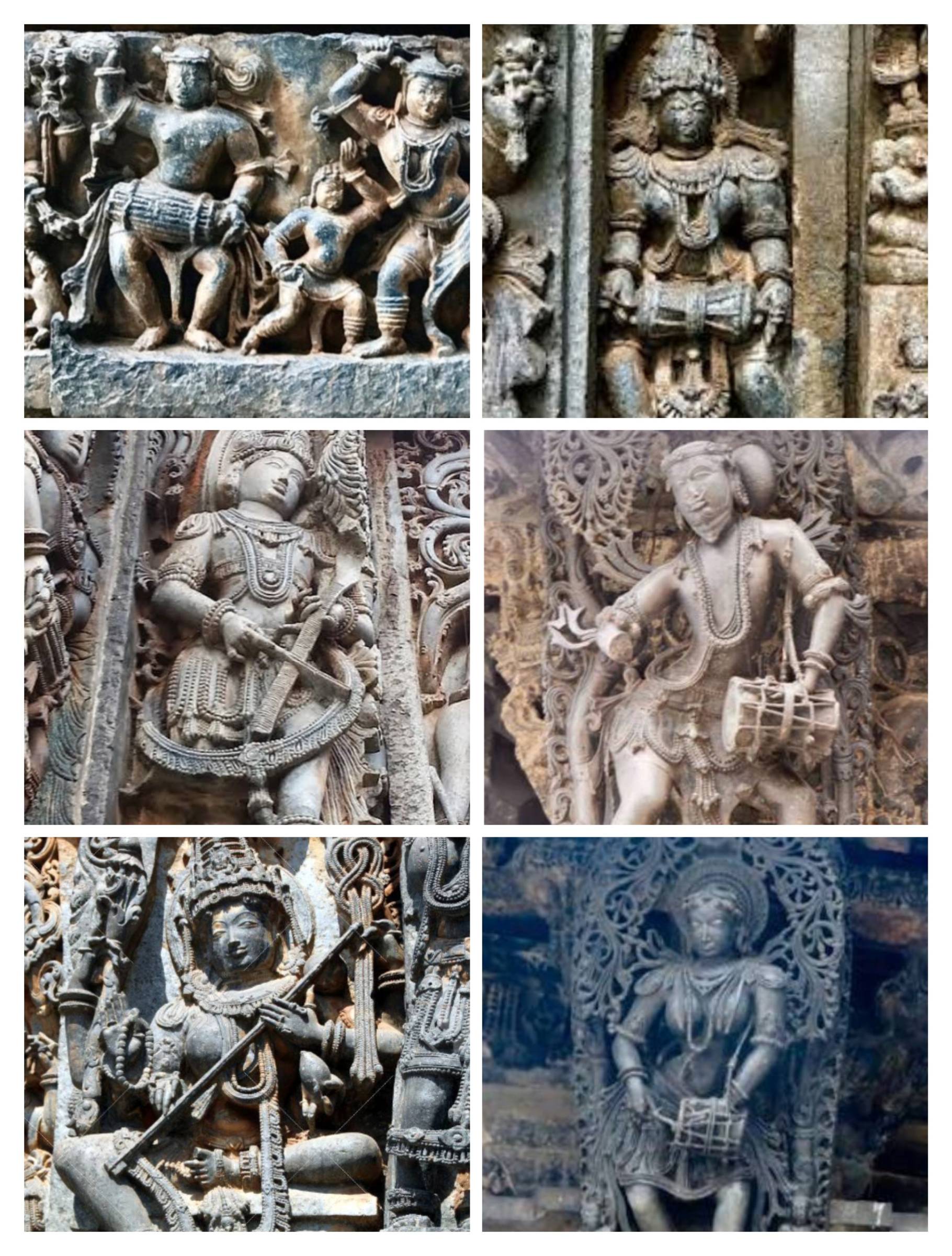
- Music during this era was monophonic, and instruments such as the veena and dundubhi (drum) were used for ritualistic accompaniment.
- The chants followed a system of three notes (Udatta, Anudatta, Svarita), forming the proto-scales that would eventually evolve into the seven-note (saptasvara) scale.
2. Sangita in the Post-Vedic and Epic Periods (500 BCE-200 CE)
- The term “Sangita“, meaning a composite of vocal music (gita), instrumental music (vadya), and dance (nritya), emerged during the post-Vedic period.
- The Natya Shastra by Bharata Muni (circa 2nd century BCE – 2nd century CE) became the foundational text on Indian performing arts. It codified theories of raga, tala, and
- Bharata classified musical scales into 22 microtones (shruti), a significant departure from the Western 12-semitone system.
- Music was seen as an expression of rasa (aesthetic emotion), integrating performance with emotional experience.
- This period marks the beginning of the codification of musical grammar, laying the groundwork for classical traditions.
3. Gupta Period and Early Classical Formations (300-600 CE)
- The Gupta era is often referred to as the Golden Age of Indian culture, including music. This era witnessed the rise of music as a sophisticated art form supported by royal courts and temples.
- Kalidasa, the classical poet and dramatist, often included musical references in his works, indicating its importance in cultural life.
- Theoretical works such as the Dattilam by sage Dattila elaborated on the concept of jatis, which were proto ragas that formed the basis of raga classification.
- Music became more systematised, and the concept of performance aesthetics began to develop.
4. Medieval Period: Diversification and Bhakti Movement (700-1700 CE)
The medieval era was a transformative period in the history of Indian music. Two significant developments occurred:
Emergence of Hindustani and Carnatic Traditions
By the 13th century, Indian classical music had begun to diverge into two major traditions:
Hindustani Music (North India): Influenced by Persian and Islamic musical elements following the arrival of Muslim rulers. Musicians like Amir Khusrau are credited with introducing instruments such as the sitar and tabla and creating new ragas.
Carnatic Music (South India): Retained more of the ancient traditions and remained rooted in Hindu religious themes.
This bifurcation led to distinct styles in raga elaboration, tala cycles, instrumentation, and performance practice.
Bhakti Movement and Musical Democratisation
The Bhakti movement (8th-17th century) emphasised devotional expression through music.
Saints like Tulsidas, Meera Bai, Purandaradasa, and Tyagaraja composed bhajans and kirtans in regional languages.
Purandaradasa (1484-1564), often called the father of Carnatic music, systematized the lesson structure (swaravali, alankaras) still used in pedagogy today.
Music was no longer restricted to court musicians or Brahmins but became a tool for spiritual awakening among the masses.
5. Colonial Period and Institutionalisation (1700-1947)
Under British colonial rule, Indian music underwent significant changes:
- Western music notation and pedagogy influenced Indian musical education.
- Music conferences (like the All-India Music Conference, 1916) and institutions like Madras Music Academy (1928) began codifying and standardizing musical theory and performance.
- Recording technology and radio transformed how music was transmitted and consumed. Notable early recordings of Gauhar Jaan (1902) popularised classical and light classical forms.
- Despite colonial suppression of native art forms, music became a site of resistance and identity-building for Indian nationalism.
6. Modern Period: From Tradition to Globalization (1947-Present)
Post-Independence Cultural Revival
Following independence, Indian music saw a revival driven by:
- State support through institutions like Sangeet Natak Akademi (1952) and Doordarshan.
- Prominent musicians such as Ravi Shankar, M.S. Subbulakshmi, and Bhimsen Joshi elevated classical music to national and international platforms.
- Music festivals like Tansen Samaroh and Thyagaraja Aradhana celebrated classical heritage and promoted young talent.
Film Music and Popular Genres
Indian music also diversified with the rise of cinema:
- Hindi film music (Bollywood) blended classical, folk, and Western influences. Composers like Naushad and A.R. Rahman innovated with orchestration and digital techniques.
- Regional film industries developed their own music styles, often rooted in local folk traditions.
Globalisation and Fusion
- Musicians like Ravi Shankar, Zakir Hussain, and L. Subramaniam pioneered fusion genres, collaborating with Western classical and jazz artists.
- Indian music entered the world music scene, contributing to intercultural dialogue and experimental forms.
The historical evolution of Indian music is a story of continuity and innovation, deeply connected to the country’s spiritual, social, and political history. From Vedic chants to the global stage, Indian music has continually adapted while preserving its core aesthetic principles. Understanding its development helps us appreciate its depth and versatility, as well as its enduring role in shaping cultural identity. For students of music, this historical lens offers both context and inspiration for future exploration and practice.