
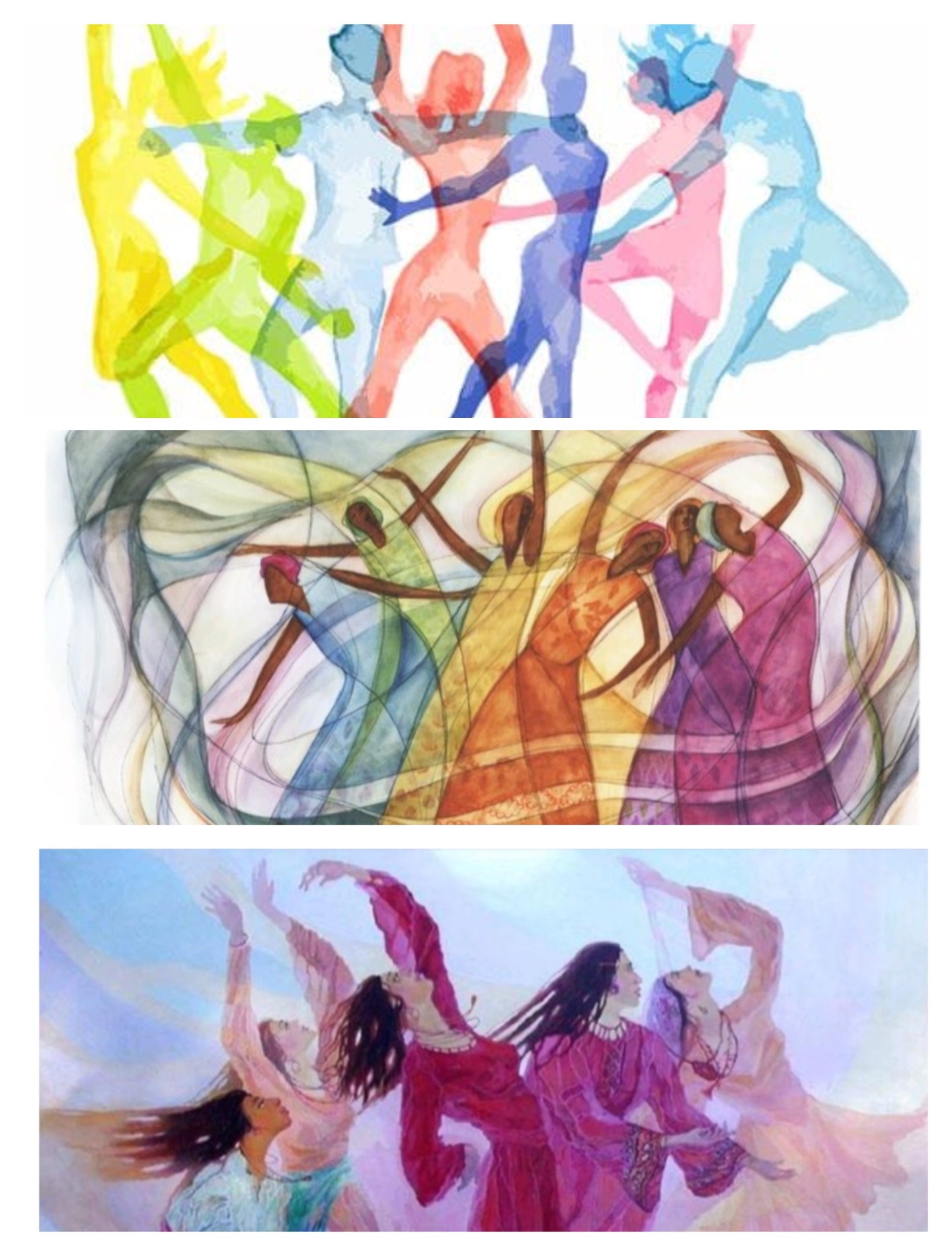
Therapeutic Dance in Education (TDIE) may be defined as both an art and a science that focuses on the pedagogical practice of teaching dance to students through innovative and learner-centred methodologies. It facilitates the creation of ‘temenos’, a Greek term denoting a “sacred space”, within which meaningful learning can occur, allowing children to explore, respond, create, perform, and critically appreciate dance. TDIE recognises and emphasises the structural dimensions of dance pedagogy, including session duration, lesson planning, clearly defined objectives, continuity between lesson plans, and the progression of learning from simple to complex movement concepts.
In addition, TDIE contributes to the development of facilitation skills among educators and supports the systematic design and implementation of a dance curriculum. It functions both as a co-curricular and cross-curricular approach, integrating movement-based learning across disciplines. The framework also incorporates movement assessment and evaluation as integral components of the teaching-learning process. For instance, when working with a hyperactive group of learners, TDIE enables the design of a curriculum that directly addresses and constructively engages with such behavioural and kinetic needs. Furthermore, TDIE allows for the customisation of dance pedagogy to suit diverse age groups, thereby ensuring developmental appropriateness and inclusivity.
Objectives of Therapeutic Dance in Education (TDIE)
- To facilitate creative self-expression and the articulation of individual identity through movement.
- To enhance the range of motion and develop bodily flexibility and mobility.
- To promote physical fitness and overall physiological well-being.
- To cultivate socio-cultural awareness by integrating elements from classical, folk, and diverse global dance forms, as well as imaginative movement practices.
- To support skill development through the use of hand gestures, spatial awareness, rhythmic coordination, and structured movement patterns.
- To encourage holistic personality development by fostering qualities such as eye contact, self-confidence, and expressive presence.
- To harness the therapeutic potential of dance by creating a safe space for emotional expression and facilitating the integration of mind, body, and soul.
- To integrate dance with education by employing movement-based approaches to teach academic subjects such as mathematics, science, and history.
Creative Movement Approaches in Therapeutic Dance in Education (TDIE)
- TDIE facilitates the learning of the fundamental “alphabets” of dance, enabling learners to understand basic movement components and structures.
- It operates on universal principles of dance rather than technique-specific training, focusing on core elements such as body, space, time, energy, and motion.
- TDIE supports the development of a Personal Movement Language (PML), encouraging individuals to generate their own movement vocabulary. Instead of imposing predefined movements on a group, it draws movement from each participant, based on the premise that dance is a primal form of expression that must be discovered and activated from within.
- Spontaneity is recognised as a central component of TDIE, allowing movement to emerge organically in response to internal and external stimuli.
- TDIE channels and strengthens the mind–body connection, fostering heightened bodily awareness and cognitive engagement.
- The approach extends beyond abstract movement to include expressive movement, thereby integrating emotion, intention, and meaning into physical action.
- TDIE adopts a non-competitive, simple, and exploratory framework that emphasises individuality, enabling learners to develop self-awareness and a deeper understanding of their own bodies.
To achieve the above objectives, TDIE utilises a Movement Activity Basket derived from principles of Dance Therapy. This structured resource comprises approximately forty-five thematic areas, including aspects such as body coordination and eye contact. While the basket contains a range of prefabricated activities, it also allows educators the flexibility to incorporate additional activities based on contextual and learner-specific needs. Furthermore, the movement activity basket includes ritualistic practices designed for educators, recognising the importance of self-care and well-being in sustaining effective pedagogical engagement.
Therapeutic choreographies are also a part of TDIE. Using the above activity basket, a movement curriculum is created in the following six stages:
- Movement Initiation: It entails seeding a movement into the body. It should be done playfully to achieve complete movement potential.
- Movement Development: It helps add to the repertoire by challenging the students to take more risks.
- Interactive Movement: It includes mirroring, shadowing, group sculpture. All these activities assist in developing bonding between the group members.
- Movement Narrative or Theme: It involves visualising a movement and expressing it through the body.
- Prefabricated Movement: It helps initiate, learn and memorise a structured movement.
- Dance Choreography: One can create his or her own meaningful movement.
For each of the above stages, there are various activities to achieve them.
According to Educational technology, there are six different ways in which people learn :
- Passive Learning: One learns without questioning. There is only one-way communication. For example, in the case of classical dancing. Here, the teacher teaches in a structured way, and the student has to learn in the exact same manner without questioning it.
- Interactive Learning: It involves two-way communication wherein the students interact with the teacher as well as with the other co-students.
- Experiential Learning: It entails physicalising everything and practically doing things experientially.
- Collaborative Learning: It involves equal partnership of people.
- Emergent Learning: It is the learning derived from a difficulty that emerged in the group.
- Latent Learning: It is the learning that develops through observation. It is the internalisation of experience, but its outcome comes later. It is not immediate.
According to Jacqueline Autard, a prominent figure in dance education, widely recognised for her scholarly and pedagogical contributions to the field and author of influential texts such as The Art of Dance in Education and Dance Composition, there are three models of Dance in Education:
The first model is called the Educational Model – It is more process oriented. It includes exploration, creativity, spontaneity, personal experience, the five movement principles, absence of technique, use of open methods and no performances. It creates more movement material. Such a model proved very useful in primary schools.
The second model is called the Professional Model – In this case, the product is more important. This model is performance oriented. There is concentration on any one dance form. Hence, it is very structured. Technique become extremely significant. It is also lengthy in terms of time scale. For example, mastering a classical dance takes many arduous hours and years of practice.
The third model is called the Mid-way Model – It is a combination of the both the above models. It employs the five principles of movement along with the open and closed methods, i.e., free movement and structured movement.
Every collaborator, instructor or teacher should be aware of their teaching technique.
Structure of a session:
There are eight steps used in a session. These are:
- Review
- Body prep
- Exploring an idea
- Developing a skill
- Creative movement
- Movement technique
- Cool down and ending
- Verbal reflection
Academics through Dance:
Dance is used as a teaching technique to reinforce and sustain interest in academic subjects. The collaborators encourage the group the “Dance the lesson” so that they can memorise the concepts with greater ease. This can be achieved in 2 ways:
- Utilisation of movement activities already existent to teach a concept. These are pre-existing activities. For example, the solid, liquids and gas activity. The children huddle tightly to become the atoms of a solid, slightly more scattered to become the atoms of a liquid and extremely far away to demonstrate the atoms of gases.
- Choosing a topic and creating an activity for it. Improvisation may be used in this activity, i.e., would it be a locomotor or non-locomotor activity, would it be structured or improvised etc.
Therapeutic Dance in Education represents a dynamic integration of pedagogical theory and embodied practice, redefining dance education through innovative and learner-centred approaches. By cultivating a temenos, or sacred learning space, it moves beyond conventional instructional frameworks to enable experiential, reflective, and transformative learning. It supports creative self-expression, enhances physical well-being, and fosters socio-cultural awareness through engagement with diverse dance forms and movement practices.
Grounded in principles of spontaneity and individuality, it draws upon a structured movement activity basket informed by Dance Therapy. The curriculum unfolds through six progressive stages, ultimately guiding learners toward the creation of personally meaningful choreography. Recognising diverse learning styles, it employs three established models of Dance in Education along with eight systematically designed session steps, ensuring both structure and flexibility in pedagogical delivery.
Through its integrative framework, it effectively aligns dance with academic learning, promoting holistic development across cognitive, physical, emotional, and social domains. Consequently, it not only enriches dance pedagogy but also functions as an inclusive and intensive educational approach, adaptable to learners across varied age groups and socio-cultural backgrounds.